Sensitization and intergranular corrosion of stainless steel pipes
Mitigating Sensitization and Intergranular Corrosion in Stainless Steel Pipes: Leveraging Low-Carbon Grades and Welding Optimization for Chromium Depletion Resistance
In the labyrinthine networks of chemical processing plant life, offshore oil structures, and pharmaceutical pipelines, in which corrosive elixirs—be they acidic brines, chloride-laden seawater, or prime-temperature vapors—gnaw relentlessly at steel boundaries, stainless-steel pipes come to be the indomitable vanguards. Among those, austenitic grades like these specified in ASTM A312, relatively TP316L, stand as paragons of resilience, their sixteen-18% chromium mantle protecting opposed to pitting and crevice assault. Yet, this armor harbors a Achilles' heel: sensitization, the insidious precipitation of chromium carbides at grain obstacles for the period of welding, which depletes adjacent areas of shielding Cr, rendering the heat-affected region (HAZ) a fertile ground for intergranular corrosion (IGC). This phenomenon, recurrently dubbed "weld decay," manifests as serpentine fissures alongside grain facets, compromising structural integrity and inviting leaks that cascade into operational halts, environmental spills, or catastrophic failures. For TP316L pipes—seamless or welded conduits for top-power, corrosive service—the stakes boost: an insignificant 0.03% carbon ceiling within the "L" (low-carbon) variant versus 0.08% in familiar 316 can mean the distinction among a long time of provider and untimely death. By orchestrating low-carbon alloying with surgical precision in welding parameters—curtailing heat input, modulating interpass temperatures, and deploying stabilizing fillers—engineers can exorcise chromium depletion, ensuring HAZ durability endures the thermodynamic tempests of fabrication without succumbing to IGC's electrochemical siege.
The genesis of sensitization unfurls inside the fiery crucible of welding, wherein austenitic stainless steels, with their face-established cubic lattices, dance on the knife-fringe of segment stability. During processes like fuel tungsten arc welding (GTAW) or shielded metal arc welding (SMAW) for A312 pipes, the HAZ— that ephemeral band 1-five mm huge flanking the fusion line—cycles thru 450-900°C, the infamous "sensitization window." Here, carbon atoms, nomadic at those temperatures, diffuse to grain obstacles, the place they best friend with chromium to forge Cr23C6 carbides, in line with the reaction 23Cr + 6C → Cr23C6. This precipitation, thermodynamically liked as ΔG = -RT ln(K) dips negative above 500°C, depletes the boundary-adjacent matrix to Cr phases less than the 12-thirteen% threshold for passive movie formation (Cr2O3). The consequence? A chromium-depleted halo, 2-10 μm broad, riddled with anodic websites at risk of preferential dissolution in competitive media, as in line with the Evans diagram: anodic currents surge at the same time as cathodic reduction lags, accelerating groove-like attack along boundaries. In TP316L, this depletion manifests subtly—in all probability a 20-30% Cr drop from 16.5% nominal—but satisfactory to minimize corrosion resistance, with IGC prices escalating 10-100x in boiling nitric acid consistent with ASTM A262 Practice E (Strauss examine). For pipes under cyclic loads or bitter service (H2S-encumbered), this evolves into strain corrosion cracking (SCC), the place cracks propagate at velocities >10^-3 mm/h, according to slip-dissolution units amplified through boundary weakness. Microscopically, electron backscatter diffraction (EBSD) shows those zones as low-perspective boundary clusters, their misorientations <5° fostering trouble-free crack highways, at the same time Auger spectroscopy confirms C/Cr enrichment at features.<p>
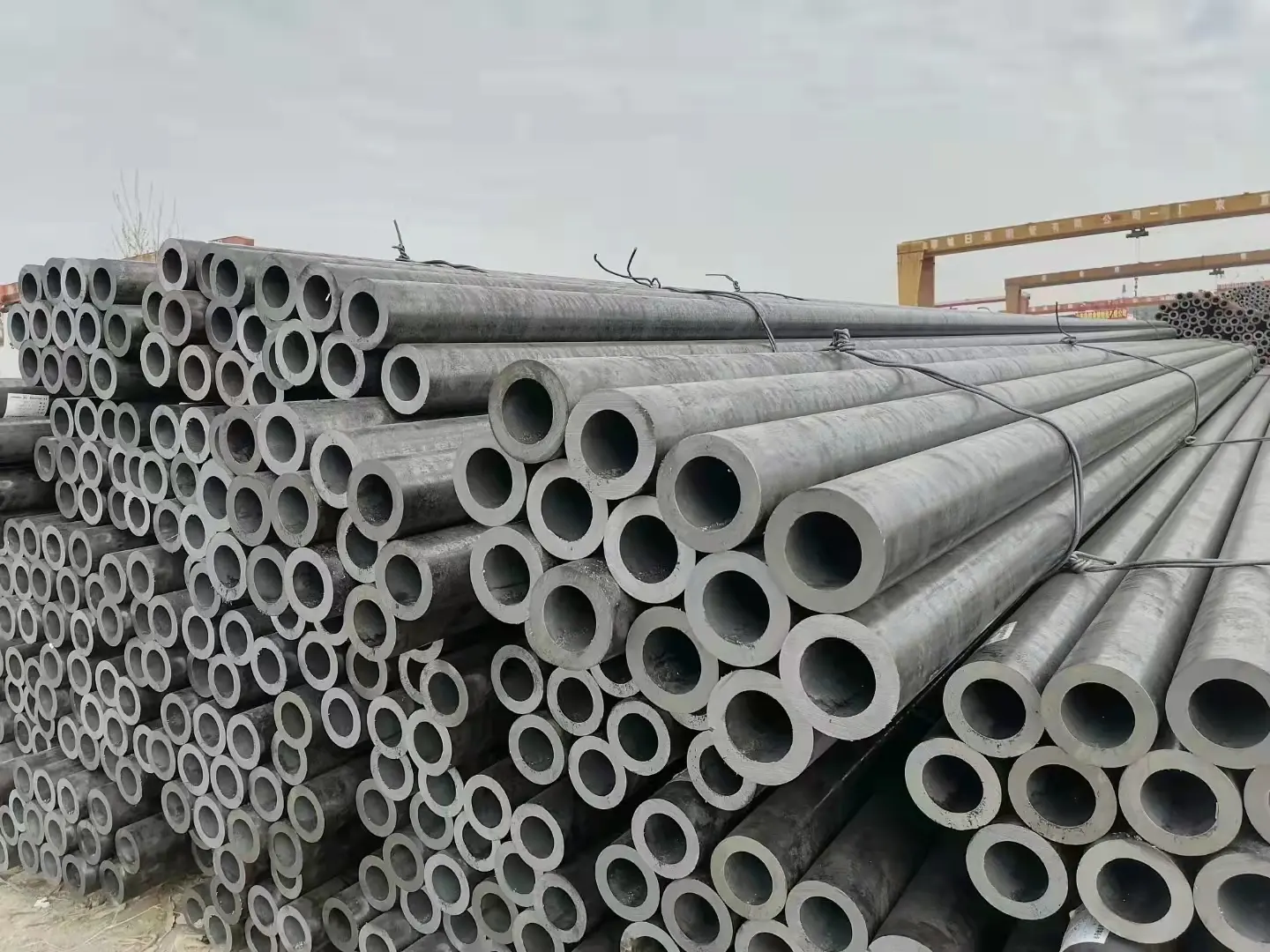
Enter the bulwark of low-carbon grades: the "L" designation in ASTM A312 TP316L, mandating C ≤zero.03 wt% (as opposed to zero.08% in TP316), slashes carbide precursors, starving the sensitization beast. This is just not serendipity yet calculated metallurgy—low C curbs the carbon endeavor a_C = exp(μ_C / RT), in which μ_C plummets with dilute interstitials, rendering Cr23C6 nucleation prices negligible even in prolonged HAZ sojourns. ASTM A312, governing seamless, welded, and bloodless-worked austenitic pipes for corrosive provider, enshrines this in its chemical tableau: for TP316L, Cr sixteen.0-18.0%, Ni 10.zero-14.zero%, Mo 2.zero-three.zero%, Mn ≤2.zero%, P/S ≤0.0.5/0.03%, Si ≤zero.75%, and that pivotal C max zero.03%, making sure a Pitting Resistance Equivalent Number (PREN = Cr + 3.3Mo + 16N) >24 for chloride defiance. Heat healing according to A312—resolution annealing at 1010-1120°C followed via immediate quench—dissolves any nascent carbides, restoring Cr homogeneity, even as the spec's nondestructive electric powered exams and hydrostatic proofs (to 2x design force) validate integrity. In practice, 316L pipes convey <1% IGC penetration after 24-hour Huey exams (boiling sixty five% HNO3), as opposed to 5-10% for 316, as carbide amount fractions hover <0.1 vol% put up-weld. The Mo alloying, at 2-three%, similarly stabilizes the passive film, yet that is the C clamp that in actual fact thwarts depletion: thermodynamic modeling thru Thermo-Calc predicts Cr dips <2% in 316L HAZs versus <a href="https://www.pipeun.com">piping system five-7% in 316, even at seven hundred°C holds.
Yet, low C is a prophylactic, not a panacea—weld geometry, skip multiplicity, and thermal cycles can still nudge obstacles into peril. Hence, welding optimization emerges because the virtuoso's contact, satisfactory-tuning the calories symphony to circumvent the sensitization nocturne. Paramount is heat input Q = (V I η)/SS (V=voltage, I=present day, η=efficiency, SS=commute speed), distinctive <1.five kJ/mm for skinny-walled A312 pipes to compress HAZ widths less than 2 mm, minimizing time-temperature exposure in step with the Scheil equation for carbide increase: X = 1 - exp(-k t), in which k ∝ exp(-Q/RT) and t is fleeting at low Q. For GTAW on 316L, arcs at eighty-120 A, 10-12 V, and one hundred-150 mm/min yield Q~zero.8 kJ/mm, birthing slender fusion traces with Cr gradients <1%, as finite portion thermal types (ANSYS) forecast top temps 1400°C at the bead yet immediate decay to <six hundred°C inside five s, outpacing diffusion lengths D = D0 exp(-Q_d/RT) ~10^-12 m²/s. In multipass welds for girth joints on extensive-diameter pipes (e.g., 24" OD), sequencing—root with GTAW, fill with SMAW—distributes warmness, however unchecked buildup disadvantages "knifeline attack," a delta-ferrite reversion zone sensitized at 800-900°C. Optimization counters with stringer beads over weaves, reducing dilution and overlap widths <3 mm.<p>
Interpass temperature T_ip, that thermal chaperone, needs vigilant capping at one hundred fifty-2 hundred°C for 316L, in step with AWS D18.1 for piping; exceeding 250°C prolongs boundary residency in the 500-800°C band, inflating carbide thickness from 50 nm to 200 nm and Cr halos to 15 μm, per time-temperature-sensitization (TTS) curves calibrated using ASTM A262 Practice A (oxalic acid etch revealing ditch constructions). Preheat, customarily nil for austenitics as a result of low thermal conductivity (okay~15 W/mK), reveals area of interest in thick partitions (>10 mm) at 100°C to blunt thermal gradients, although pressured-air cooling submit-pass quickens to <10°C/s, shrinking the sensitization integral ∫ t(T) dT beneath 10^four °C-s thresholds for immunity. Filler metals amplify this: ER316LSi (with Si>zero.65% for fluidity) or stabilized ENiCrMo-three in shape base Cr/Ni, however low-C variations (C<0.02%) and Nb/Ti additions (zero.5-1.0%) scavenge C as NbC/TiC, in step with Zener pinning, preempting Cr23C6. In bitter gasoline traces, NACE MR0175-compliant fillers determine HIC resistance along IGC aversion.<p>
Post-weld heat medicine (PWHT) crowns the technique for high-chance welds: resolution annealing at 1050°C for 1 h in keeping with 25 mm thickness, quenching in water, redissolves carbides by means of Fickian diffusion J = -D ∇C, restoring Cr to 16%+ throughout limitations, with ASTM A312 mandating this for improved grades. For box girth welds on 316L pipes, in spite of this, PWHT's logistics falter—induction heating bands at six hundred-800°C for 2 h be offering a compromise, relieving residuals devoid of full anneal, nevertheless stabilization (Ti/Nb) variants like 321/347 eclipse this desire. A 2025 gain knowledge of on GTAW'ed 316L tubes quantified this: optimized low-Q (0.5 kJ/mm) + T_ip=a hundred and fifty°C yielded 0 sensitization according to ASTM G28 (ferric sulfate), as opposed to 15% Cr depletion and 0.2 mm/yr IGC in prime-Q (2.five kJ/mm) analogs.
Synergies among alloy and job yield exponential safeguards. In ASTM A312 TP316L, the low-C baseline dovetails with Q optimization: even at mild inputs (1.2 kJ/mm), Mo's passivation buffers minor depletions, PREN gradients <2, guaranteeing <zero.05 mm penetration in forty eight-hour Streicher tests (A262 Practice <a href="https://www.steelpipeline.net/">alloy steel pipe B). For spiral-welded pipes, helical progression inherently dilutes warmth, however parameter tuning—arc voltage modulation using inverters—ensures uniformity. Best practices cascade: pre-weld cleansing (acetone degrease, no chlorides) averts pitting nucleation; inert protecting (Ar>ninety nine.99%) quells oxidation; and in-process tracking because of thermocouples or IR pyrometers feeds closed-loop controls, tweaking modern-day in proper-time to cap T_ip. Standards orchestrate this ballet: ASME B31.three for process piping echoes A312's quals, mandating approach qualification facts (PQRs) with IGC sims, when ISO 15590-five small print welded joint quals for subsea traces.
Empirical vignettes remove darkness from the dividends. A 2024 retrofit on a Gulf Coast refinery's 316L effluent lines—plagued by using IGC fissures publish-SMAW girth welds—deployed ER316L fillers at 1.zero kJ/mm enter and 120°C T_ip, slashing corrosion fees from zero.five mm/y to
Challenges linger—delta-ferrite strings (three-8 FN) in 316L welds can harbor C, nevertheless laser welding's precision (Q
In summation, vanquishing sensitization in chrome steel pipes calls for a duet: the prophylactic poise of L-grades like TP316L, throttling carbon to starve carbides, and the kinetic finesse of welding optimization, compressing thermal odysseys to stay clear of depletion's seize. From ASTM A312's compositional edicts to parameter symphonies, this alchemy guarantees HAZs remain Cr-clad fortresses, their grains unscarred with the aid of IGC's etch. In the corrosive coliseum, these vessels no longer most effective bear yet excel—testaments to metallurgy's mastery over entropy's sophisticated sabotage.